
Pests and Diseases
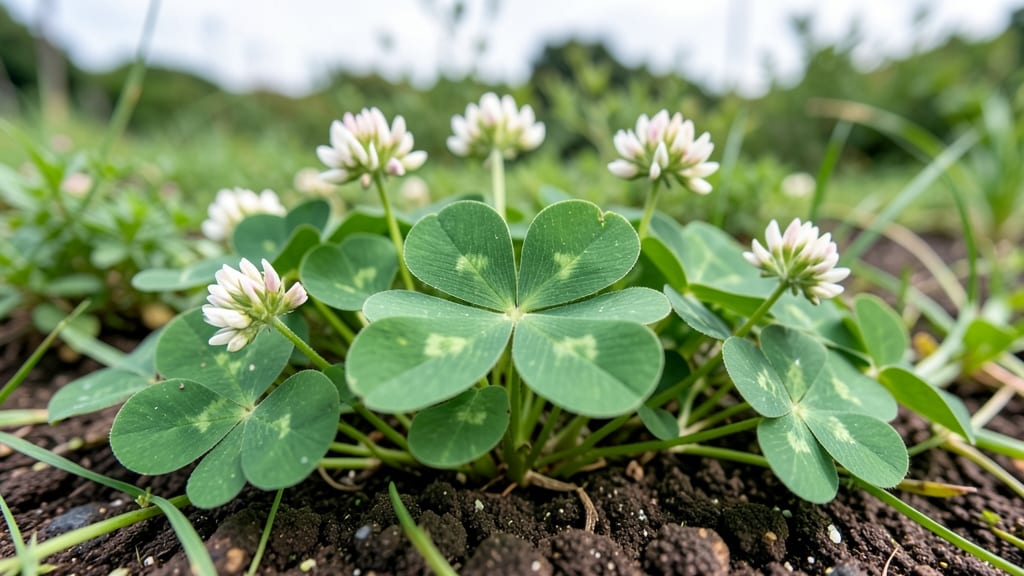
Yes, there is such a thing as a four-leaf clover, and it exists as a natural mutation of the common three-leaf shamrock, though they’re rare—estimated at 1 in 10,000 plants. Their extra leaf symbolizes luck, but finding one requires patience and keen observation in healthy, dense clover patches.
Four-leaf clovers aren't just folklore—they're real botanical oddities caused by a genetic mutation that duplicates one of the three original leaves. 🌱 This rare variation occurs naturally when a clover plant's chromosomes misalign during cell division, creating that coveted fourth leaf.
While the odds are slim, your chances improve in well-maintained lawns where clovers thrive in moist, sunny conditions. Many gardeners swear by searching after rain when leaves are fully unfurled and easier to spot.
What makes these lucky clovers so special isn't just their rarity—it's their symbolic power across cultures. The extra leaf represents hope, faith, love, and luck, making them a popular motif in jewelry and tattoos.
Interestingly, while four-leafers are the most famous, you can also find five-, six-, and even seven-leaf clovers, though these are even rarer. The key to spotting one is patience combined with the right conditions and tools like a magnifying glass or UV flashlight to reveal hidden leaves.
💡 In This Article
- The Science Behind Four-Leaf Clover Mutations
- Maximizing Your Chances of Finding a Lucky Clover
The science behind four-leaf clover mutations
The fourth leaf on a clover isn't just luck—it's a genetic quirk caused by a chromosomal mutation called tetrasomy. During cell division, a clover's chromosomes sometimes fail to separate properly, resulting in an extra set of genes that trigger the growth of that fourth leaf.
This mutation occurs in about 0.05% of clover plants, making four-leafers roughly 1 in 10,000 compared to standard three-leaf varieties. 🌱 The extra leaf doesn't affect the plant's survival but does make it stand out visually.
Sunlight plays a crucial role in revealing these rare clovers. Healthy clover patches need 6-8 hours of direct sunlight daily to develop vibrant leaves that make the fourth one easier to spot.
Soil health matters too—clovers thrive in well-drained soil with a pH between 6.0 and 7.5, rich in nitrogen and phosphorus. Interestingly, while four-leafers are famous, clovers can also develop five or even six leaves through similar mutations, though these are even rarer due to more complex chromosomal rearrangements.
What most people don't realize is that the fourth leaf's position isn't random. It typically grows from the same stem as the other three leaves, often appearing slightly larger or differently shaped. This makes it easier to identify once you know what to look for.
The mutation isn't hereditary—each four-leaf clover is a unique fluke of nature, which is why finding one feels like striking botanical gold. 💫
Environmental factors also influence visibility. After rainfall, clover leaves unfurl fully, making the fourth leaf more apparent against the bright green background. In dry conditions, leaves curl inward, potentially hiding the extra leaf.
This is why experienced clover hunters recommend searching after gentle rains when leaves are fully expanded and the extra leaf is most likely to be visible.
While four-leaf clovers are the most famous, botanists have documented clovers with up to 12 leaves, though these are extremely rare.
The record-holder is a 17-leaf clover found in Japan in 2009, proving that while four leaves are special, nature's creativity knows no bounds when it comes to leaf variations. The key takeaway is that these mutations aren't just random—they're influenced by a perfect storm of genetics, sunlight, and soil conditions.