
Pests and Diseases
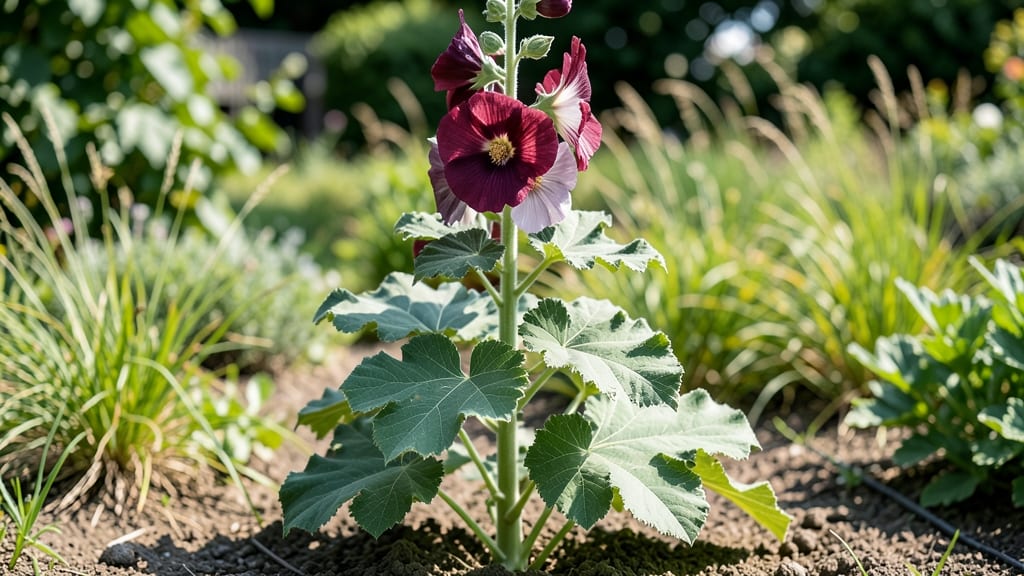
The hollyhock leaf shape is characterized by deep palmate lobes with 3-7 sharp, pointed segments that spread outward from a central point, creating a rugged, maple-like silhouette. These leaves often appear coarser than maple leaves, with pronounced serrations along each lobe edge.
The hollyhock's distinctive leaf structure isn't just visually striking—it plays a key role in plant identification and health. 🌿 The central stem where lobes meet is called the petiole, and the number of lobes can vary between cultivars, with some like 'Chater's Double' showcasing broader segments.
These leaves also feature prominent veins that create a web-like pattern, which helps channel nutrients efficiently. Understanding this anatomy helps gardeners spot early signs of stress, like yellowing between veins, which often signals nutrient deficiencies or fungal issues.
What's fascinating is how this leaf shape evolved as an adaptation. The deep lobes maximize surface area for photosynthesis while reducing water loss—a clever survival trait for hollyhocks native to dry Mediterranean regions.
When selecting plants, pay attention to how the lobes' sharpness and spacing change between varieties: some like 'Black Night' have more pronounced serrations, while others like 'Helen Campbell' maintain a slightly softer outline. This variation makes leaf shape a valuable tool for cultivar identification at a glance.
💡 In This Article
- Botanical Breakdown of Hollyhock Leaf Anatomy
- How Leaf Shape Impacts Hollyhock Cultivation
Botanical breakdown of hollyhock leaf anatomy
The hollyhock leaf's palmate structure begins with a central stem called the petiole, from which 3-7 deep lobes radiate outward like fingers on a hand.
These lobes typically measure 2-6 inches long and 1-3 inches wide, creating a rugged silhouette that distinguishes hollyhocks from their milder Malvaceae relatives like mallow.
The lobes themselves are further divided by secondary veins that form a web-like pattern, enhancing structural integrity while optimizing photosynthesis. 🌿 This venation system is particularly visible when backlit, revealing intricate patterns that resemble lace.
What sets hollyhock leaves apart from maple leaves is their coarser texture and sharper serrations. While maple leaves have smooth, rounded lobes, hollyhock lobes often feature 3-5 pointed teeth along each edge, giving them a jagged appearance.
The leaf margin's serration depth varies by species: Alcea rosea (common hollyhock) typically displays more pronounced serrations, while Alcea palmatissecta cultivars often have finer, more delicate edges. This variation is why botanists use leaf shape as a key identifier when distinguishing between hollyhock species.
The leaf's lobing pattern isn't just ornamental—it's an evolutionary adaptation. The deep cuts increase surface area by up to 30% compared to simple leaves, allowing hollyhocks to capture more sunlight in their native dry climates.
This structure also creates microclimates that reduce water evaporation, a critical survival trait for plants growing in USDA zones 3-9. Interestingly, the central petiole often exhibits a reddish-purple hue when young, which fades as the leaf matures—a visual cue that helps identify healthy growth.
When comparing hollyhock leaves to other Malvaceae family members, the differences become clear. Mallow leaves, for example, tend to be less deeply lobed and more rounded, with smoother margins. The hollyhock's palmate structure is more extreme, with lobes sometimes extending twice as far from the central point.
This exaggerated form is one reason why hollyhocks make striking garden focal points, as their bold foliage contrasts sharply with softer-leaved plants. 🌸 The leaf's texture also plays a role in pest resistance—the coarse, lobed structure makes it harder for insects to establish feeding sites compared to smoother leaves.
Understanding these anatomical details helps gardeners make informed choices. For instance, cultivars like 'Black Night' feature broader, more pronounced lobes that create dramatic shadows, while 'Helen Campbell' offers narrower, more delicate segments suited for mixed borders.
The leaf's venation pattern also serves as an early warning system: if the veins turn yellow before the leaf does, it often signals magnesium deficiency—a common issue in alkaline soils. Paying attention to these botanical specifics ensures you can provide the right care for your hollyhocks to thrive.