
Pests and Diseases
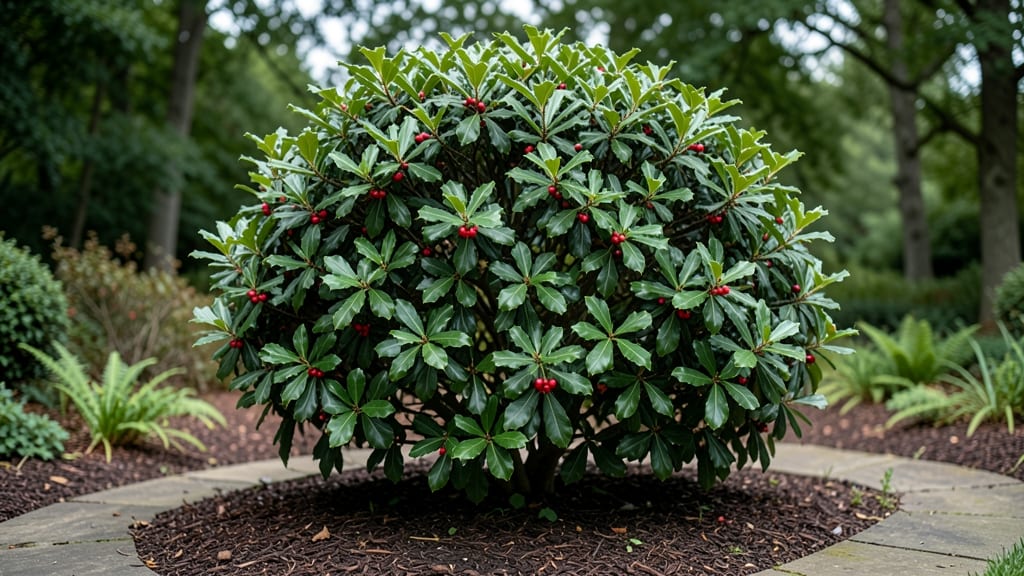
Identifying holly leaf shapes starts with their signature glossy, spiny-edged foliage arranged alternately along stems, often featuring leathery textures and sharp tips. English holly boasts smooth-edged leaves, while American holly displays serrated margins.
Holly leaves aren't just decorative—their unique shapes help distinguish between species at a glance. 🌿 The spines along the edges, for example, can be soft or razor-sharp depending on the variety, with American holly often showing more pronounced serrations.
Leaf size also varies dramatically: some dwarf varieties like 'Sky Pencil' have narrow, almost needle-like foliage, while others like 'Blue Princess' develop broad, deep-green leaves perfect for hedges.
This diversity makes holly an excellent choice for both ornamental gardens and wildlife-friendly landscapes, as the spiny leaves deter pests while providing food for birds in winter.
What's fascinating is how these leaf traits evolved—many holly species developed their spiny edges as a natural defense against herbivores. 🔥 This adaptation not only protects the tree but also creates striking visual contrast in winter when the leaves remain evergreen.
Whether you're identifying a tree in your yard or selecting one for landscaping, paying attention to these leaf characteristics will help you choose the perfect holly for your needs.
💡 In This Article
- How to Distinguish Holly Leaf Shapes by Species
- Best Holly Varieties for Landscaping by Leaf Characteristics
How to distinguish holly leaf shapes by species
The most reliable way to identify holly species is by examining three key leaf characteristics: margin type, spine density, and leaf size.
English holly (Ilex aquifolium) typically features smooth-edged leaves with 2-4 soft spines per side, while American holly (Ilex opaca) displays sharp serrations with 4-8 spines that can reach 1/4-inch in length.
The spine arrangement follows a parallel vein pattern, where each spine emerges from a vein rather than the leaf edge.
Leaf size provides another critical clue—English holly leaves average 2-4 inches long with a 1-2 inch width, while American holly leaves are slightly larger at 3-5 inches long and 1.5-3 inches wide.
The leathery texture is universal across species, but the shininess varies: English holly leaves have a deep glossy finish, while American holly often appears slightly duller due to finer wax coating. 🌿 These differences become especially noticeable when comparing fresh spring growth to mature leaves, where the spines may soften slightly with age.
For accurate identification, examine the leaf underside too—the veins are more pronounced in American holly, creating a network pattern that's less visible in English holly. This vein structure affects how the leaves catch light, with American holly often showing iridescent highlights when backlit.
The leaf base also differs: English holly has a rounded base, while American holly typically features a wedge-shaped base that tapers toward the stem.
One common misidentification occurs with Chinese holly (Ilex cornuta), whose leaves have 3-5 sharp spines per side arranged in clusters rather than evenly spaced. The spines on Chinese holly are also 1/2-inch long, making them significantly more aggressive than English holly's decorative spines.
This species often grows in warmer climates and can be distinguished by its red berries that mature in 9-12 months versus the 6-8 months typical for American holly.
When examining holly leaves in winter, look for persistent leaf scars where old leaves attach—they follow the same vein patterns as the leaves themselves. These scars help identify species even when no foliage remains.
The leaf arrangement along stems is also telling: holly leaves grow alternately (one leaf per node) rather than opposite (two leaves per node), which helps distinguish them from similar evergreens like boxwood.
For gardeners, understanding these distinctions is crucial when selecting holly varieties. While English holly thrives in USDA zones 6-9, American holly prefers zones 5-9, and Chinese holly excels in zones 7-10.
The leaf shape directly correlates with cold hardiness—broader leaves like those on 'Blue Princess' English holly can suffer winter burn in colder climates, while narrower leaves like 'Sky Pencil' tolerate lower temperatures better. ✨